After Oracle Layoffs, One Employee’s Message Offers Hope and Resilience
Oracle Corporation’s 2026 layoffs, impacting up to 30,000 employees globally, reflect a major shift toward AI-driven restructuring, despite widespread workforce disruption.
Oracle has cut nearly 30,000 jobs globally, sending shockwaves across the global technology industry.
Some employees were terminated on the same day they were notified via email.
Although many working professionals have been impacted, the layoffs are part of a broader effort to restructure the company.
Amid the rising tension among the workforce, a post by a Senior Technical Program Manager has emerged as a glimmer of hope for affected employees.
Claire Fontenot stated that while the job loss came as a big surprise, she has chosen to use this time productively.
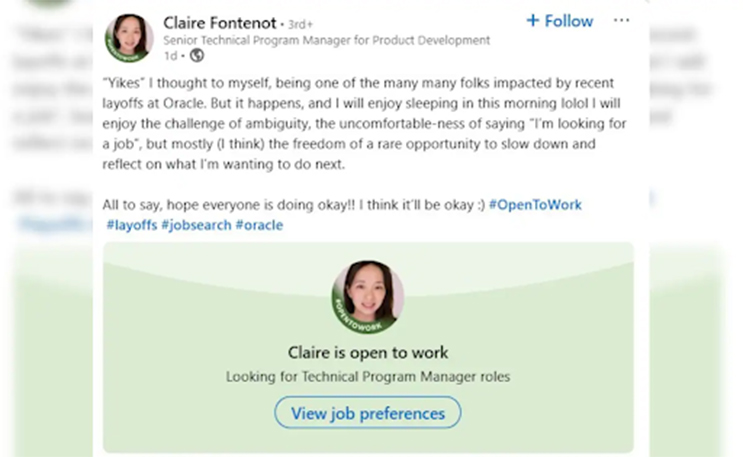
She plans to rest, reset, and reflect on her future moves.
“Yikes, I thought to myself, being one of the many, many folks impacted by recent layoffs at Oracle. But it happens, and I will enjoy sleeping in this morning lolol. I will enjoy the challenge of ambiguity, the discomfort of saying ‘I'm looking for a job,’ but mostly (I think) the freedom of a rare opportunity to slow down and reflect on what I want to do next. All to say, I hope everyone is doing okay!! I think it’ll be okay,” she wrote in her post.
Oracle had informed employees that changes would be made to streamline operations, resulting in some roles becoming redundant.
However, one of the major reasons behind the layoffs is the company’s shift toward AI and cloud infrastructure expansion. This shift implies fewer traditional roles and a greater focus on AI-driven infrastructure.
Oracle is investing heavily in AI partnerships and infrastructure, which has led to cost-cutting measures in other areas.
In India alone, around 12,000 employees have been affected.
The Oracle layoffs of 2026 represent a turning point not just for the company, but for the tech industry as a whole.
For many, Oracle’s decision is a stark reminder of the changing nature of work in the digital age. For others, like Claire Fontenot, it represents the beginning of a new chapter.